
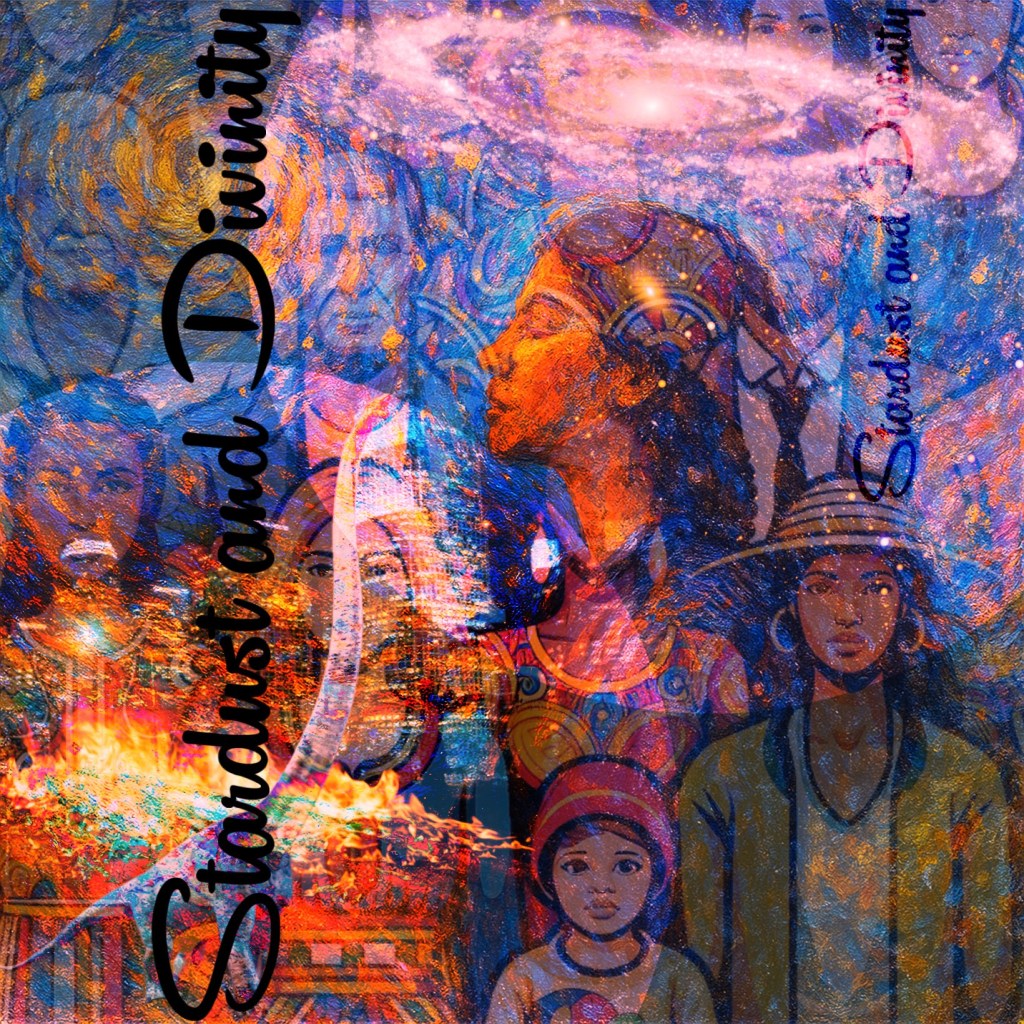
This is not a poem. It’s a quiet attempt to make sense of the faiths that surround me — the ones that have shaped my immediate and extended family, divided it, and left me wondering where my own sense of the divine belongs.
If I choose the God of one side of my family,
I’m condemned by the other
and vice versa.
If I choose none, or another altogether,
I’m condemned by both.
Whichever way I turn, I seem to be doomed.
I cannot believe in this man-made concept of divinity —
a divinity built on righteousness and the unshakable conviction
that the others must be wrong.
That is human thinking: understandable, perhaps,
given our limited capacity to truly grasp other cultures,
their histories, and their hearts —
but it breeds only friction within families,
and war among peoples and nations.
I am not against anyone being a practicing Christian,
Muslim, Buddhist, Jew, Jain, Sikh, Hindu — or anything else.
Believe, practice, pray — but do not approach me, or anyone,
with the presumption that we are wrong,
or with the mission to convert.
None of us truly knows.
If you ask whether I believe in God,
I would say I hope there is something grand —
something vast, generous, and loving
beyond what any of us can imagine.
And I do not think it lies outside us,
but within and around us —
in nature, in animals, in planets,
in people, and even in the things we call “objects.”
In the end, everything is made of stardust —
your car, your furniture, your dog, your neighbor.
Every atom on this planet — carbon, oxygen, nitrogen, hydrogen
has existed for billions of years,
forged in the fiery hearts of stars
that lived and died long before Earth was born.
Atoms do not multiply or appear out of nothing.
They only rearrange — endlessly transformed,
like cosmic Lego bricks,
finite yet capable of infinite combinations.
Life itself is the universe’s art,
the ceaseless rearrangement of these ancient pieces
into new, beautiful forms.
And when life ends, the pieces simply return to the pile,
ready to be used again.
Nothing exists that wasn’t here before.
Your fridge holds a trace of dinosaur;
your hair contains Andromeda’s glitter.
From this, I draw two humble conclusions:
our idea of linear time bends into something else,
and everything — everything — is connected.
“We are one” is not an esoteric slogan.
It is the quiet truth at the heart of it all.
If I am to believe in anything,
let it be in that recognition —
that we share this space, this matter, this breath.
Should that not make us humble?
Should it not stop us in our tracks
and make us rethink our ways?
I can only hope that one day
we will end our divisive rhetoric and remember:
we are all, every one of us —
particles of the universe.
 Eva van Beek
Danke Eva, sehr schön. LG Philippe
Danke!